
Long Fin Cherry Barb
Long Fin Cherry Barb
Couldn't load pickup availability
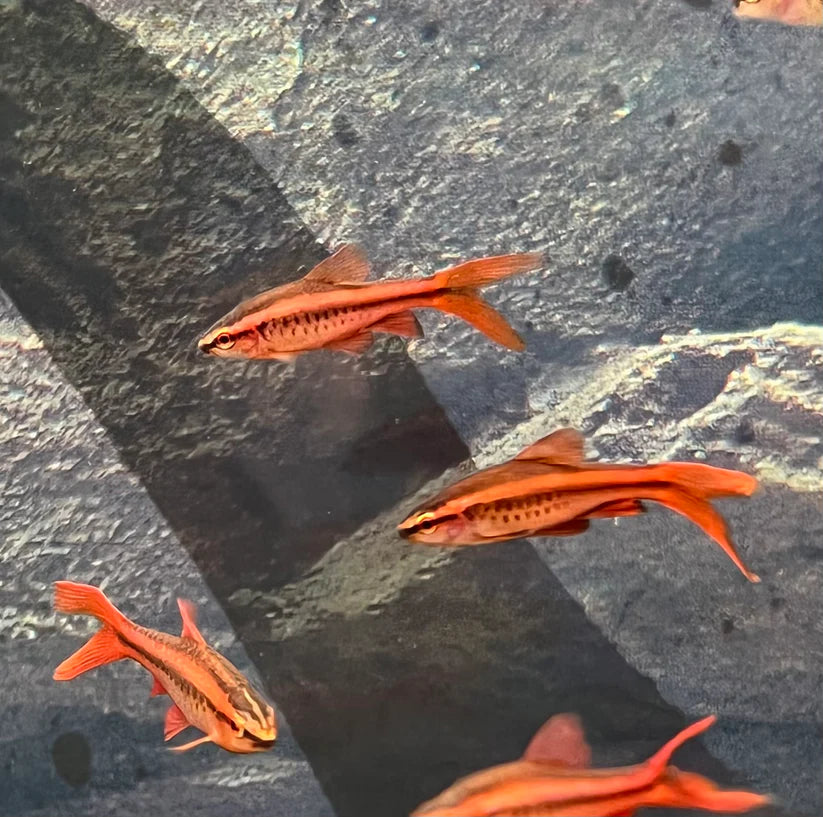
The Cherry Barb is one of the most classic and beautiful nano fish. Its hardiness, adaptability, ease of breeding, and low price make it an absolutely ideal fish for both beginners and experts.
The Cherry Barb (Puntius titteya), is a very beautiful, small barb that is extremely popular among aquarists due to its bold red coloration (especially in males), peaceful yet outgoing disposition, and very small size. This schooling fish can be the highlight in any peaceful community aquarium and it is a particular standout in the planted aquarium. Males have an overall bright red sheen while females have a golden brown and cream coloration with red highlights. When kept in a school of males and females, many males will display the most intense coloration in order to attract the attention of females.
The Cherry Barb typically occupies the middle level of the water column, although it can often be seen swimming and feeding in the top and bottom levels as well. It is safe with other peaceful, small fish. Unlike many other larger barbs, the Cherry Barb is very peaceful. Due to its extra small size, it can be viewed as similar to microrasboras and blue-eye rainbowfish as far as its compatibility with dwarf shrimp. Larger, peaceful invertebrates can also make good tankmates. When keeping the Cherry Barb with dwarf shrimp, plenty of plants and cover are recommended. It is also best to introduce the dwarf shrimp to the aquarium before introducing the Cherry Barb.
The Cherry Barb must be kept in schools of 6 or more. Not only will it display its best natural behavior and coloration in large schools, but it will also pay little attention to other species. This tank-raised fish is very hardy and adaptable, but it requires clean, well-maintained water to thrive and it will display optimal coloration and health in a planted aquarium with dark substrate, especially where floating plants are present. As long as it has plenty of cover, it is an extremely outgoing species. It is also one of the very easiest fish to breed in the aquarium.
While not a picky eater, the Cherry Barb will thrive and remain very colorful on a varied diet of mostly omnivorous foods. High-quality flake food, pellets, and live, frozen, or freeze-dried Artemia, microworms, Tubifex, and finely chopped bloodworms will all be readily accepted. However, the Cherry Barb requires a good amount of vegetable matter in its diet. It will not significantly bother most aquarium plants, especially when it is regularly fed an appropriate diet.
Â
What We Like About This Fish:
- Beautiful coloration and very small size
- Peaceful disposition with fish and peaceful invertebrates
- Very active and noticeable fish in any aquarium
- Ideal for nano and planted aquariums
RECOMMENDED TANK PARAMETERS:
- Temperature: 72° - 79° F (22° - 26° C)
- pH: 6.0-8.0
- KH: 3 - 18 dKH
- Minimum Tank Size: 10-20 gallons for a small school, although a larger tank is more ideal
CARE INFORMATION:
- Diet: Omnivore. Will easily accept high quality dry and frozen foods of appropriate size. Vegetable matter is also essential.
- Social Behavior: Peaceful, schooling/shoaling.
- Origin: Tank-bred, but indigenous to Sri Lanka
- Average Adult Size: 1.5 - 2 inches (3.8 - 5 cm), although the lower end of this range is more likely
- Average Purchase Size: .5 inch (1.3 cm)
Â
Share